A-Z GUIDE TO MOVIES AND TV SHOWS PARODIED BY MAD, CRACKED, CRAZY, ETC. UP TO 1996. THEY HAVE NOTHING TO DO WITH THIS. SPOILERS AND OTHER NON-SEQUITURS, TOO. SOMETIMES THESE THINGS HAVE WORDS OR SITUATIONS WE DON'T USE ANYMORE. YOU KNOW, 'CAUSE THEY'RE OLD.
Updated daily. There's posts besides this one archived in the sidebar on the right, you clods!
if you're at a laptop or desktop, right-click and open link on pages and they'll be clearer and legible in a new window.
Got still even more Kojak parodies. I'm starting a new folder because I wouldn't have enough room for tags. I still won't have enough room here either. But I'll try.
TV detective show about Det. Theodopolus Kojak (Telly Savalas). One of the other detectives was Stavros (George Savalas).
Cover to the German edition of Cracked.
Cover to the Brazilian edition, also parodying the TV shows Coquetel de Amor and Espelho Mágico.
From Cracked #128, October 1975, art by Sururi Gumen.
From Cracked #138, December 1976, art by John Severin. His partner was Bobby Crocker (Kevin Dobson).
KOJERK
Sick #103, April 1975
w: Len Herman
a: Jerry Grandenetti
Sucking lollipops was one of his his trademarks.
His boss was Frank McNeil (Dan Frazier)
The caricatures of Boris Karloff, Jackie Gleason, Danny Thomas, Carol Channing, and Allen Funt look like they were swiped from Al Hirschfeld.
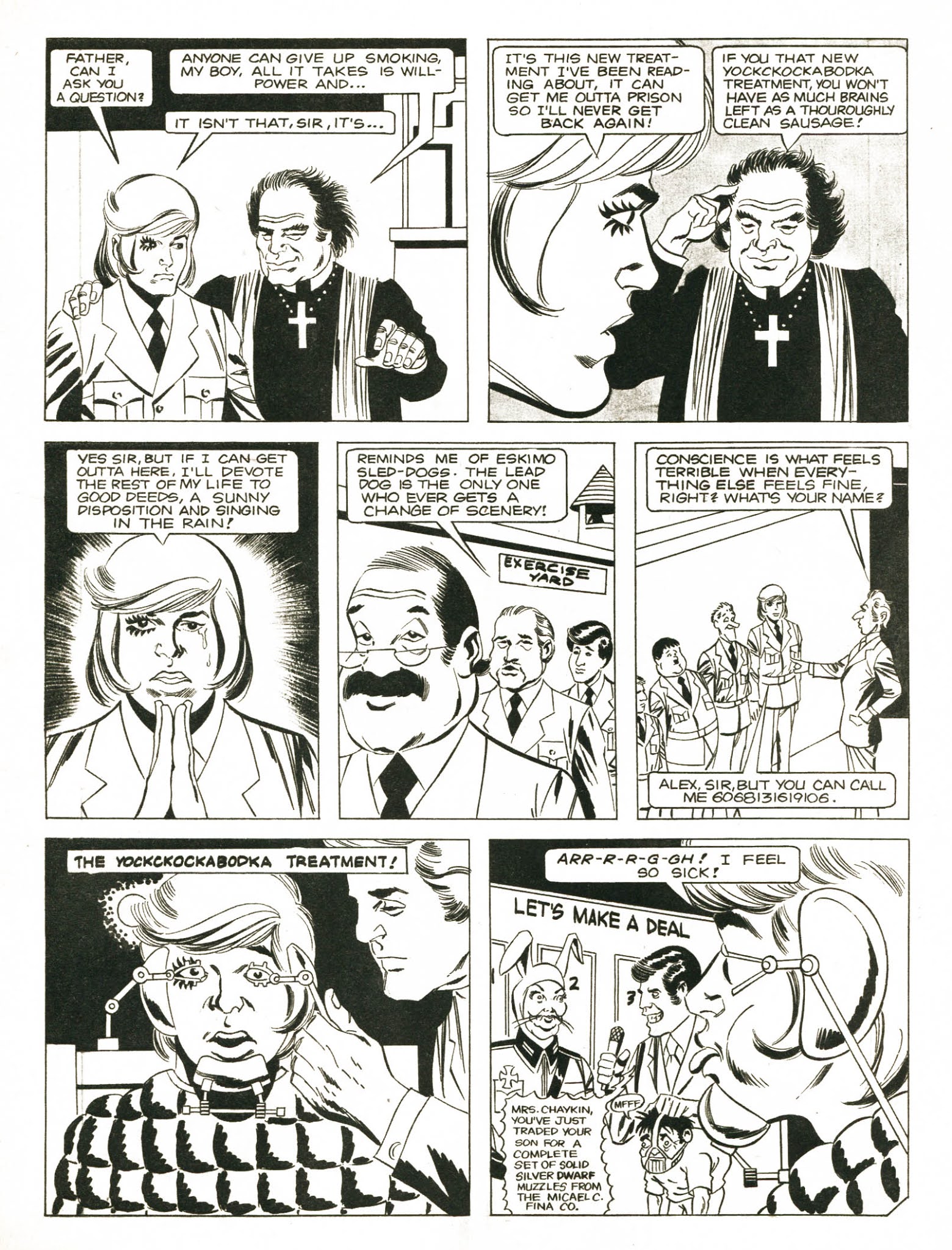
Monty Hall was host of the game show Let's Make a Deal.
A POKE IN YOUR PRIVATE EYE
International Insanity #1, July 1976
w: Fred Wolfe (Paul Laikin)
a: Terry Austin, Russ Heath, Neal Adams, Carl Potts, Jack Abel, Al Milgrom
This is really a parody of the entire detective genre, similar to the piece from the Longstreet parody last month.Because it has so many detectives and the article has so many inkers, not everything can be tagged.
International Insanity was an adult humor magazine that kept changing its name. First it was Harpoon until it got a cease and desist from National Lampoon for having a similar name, then became Apple Pie, and eventually settled on this. They usually used Marvel/superhero artists for their parodies.
The detectives here, from eponymous shows unless noted otherwise, are Mike Stone from The Steets of San Francisco (Karl Malden), Frank Cannon (Robert Conrad), Baretta (Robert Blake), Pepper Anderson of Police Woman (Angie Dickinson), Columbo (Peter Falk), McCloud (Dennis Weaver), and Jim Rockford of The Rockford Files (James Garner). I probably know who the guy with glasses and the woman with the white streaks are too and they'll come to me after this is already posted and someone will tell me and I'll feel like an idiot.
Karl Malden also did commercials for American Express. Baretta had a pet cockatoo.
The curator kind of looks like Donald Sutherland but fifteen to twenty years after this was drawn.
Also one of the detective that wasn't used in the splash is Barnaby Jones (Eddie Albert).
“Who loves ya, baby?” was Telly Savalas' catchphrase.
SHIT LIST
National Screw #3, 1977
When Hustler made a big splash, Screw, previously a regional tabloid, went toe-to-toe with them briefly, publishing a slick magazine edition, using the same formula they felt they had been using for years. Screw's formula was more 80% sex, 10% satire, and 10% a soapbox for publisher Al Goldstein to air his grievances.
THE ODDFATHER
MAD #155, December 1972
w: Larry Siegel
a: Mort Drucker
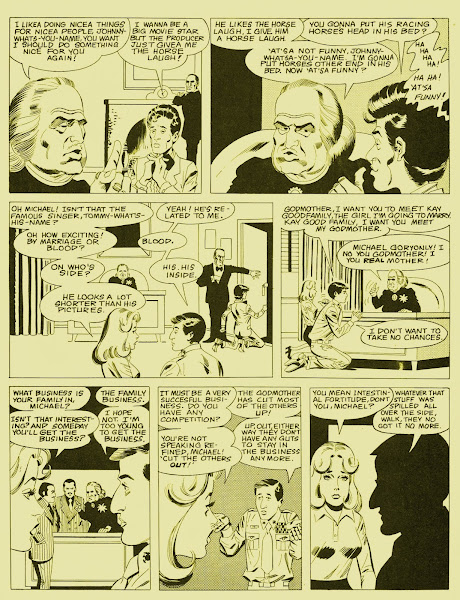
Too many pages for me to put in one post, so I'll break it in two. The rest will be tomorrow. And of course the two sequels. I guess you could say this is Godfather week. Godfather half-week, really. Let's get to it.
The movie starts with the wedding of Don Vito Corleone (Marlon Brando)'s daughter (Talia Shire) in 1945. Here we meet the family while Don Vito is inside meeting "clients". At his side is Tom Hagen (Robert Duvall), the family consiglieri, a kid of lawyer/fixer for them.
In the big panel on the bottom is Luca Brasi (Lenny Montana), rehearsing how he will talk to Don Corleone.
Michael Corleone (Al Pacino) has just left the war and has no plans to go into organized crime, like his brothers Sonny (James Caan) and Fredo (John Cazale). He aspires to be a Senator or Governor. He comes to the wedding with his fiancee Kay Adams (Diane Keaton). Inside, Don Corleone does a favor for a Mr. Bonasera (Salvatore Corsitto) but first must get the proper respect.
Johnny Fontaine (Al Martino) is said to be a stand-in for Frank Sinatra. He's a lounge singer and teen idol whose career has been made by the mob and has come to entertain at the wedding. Later, he asks the Don a favor. He wants a part in a movie but the producer Jack Woltz (John Marley) won't budge. Corleone has Tom fly out to Hollywood to pay Mr. Woltz a visit. Jack gives a tour of his property, including a stable with his prize racehorse, but still refuses to give Johnny Fontaine the part. In one of the most talked about scenes, he wakes up to find his horse's severed head in his bed.
I always found it weird that he's a big Hollywood producer and almost as unethical but he sleeps alone.
Don Corleone has refused to bribe judges and policemen and help fund the heroin operation for his rival Sollozzo of the Tattaglia family, so is subsequently gunned down and hospitalized. Michael, though not part of the mob is still family, and visits him in the hospital.
Not shown: Michael is shocked to find his father unprotected and has him moved to another room before there's a hit on him by the Tattaglia gang, the ones who attempted to murder him in the first place. As he leaves he's roughed up by cops who are the ones that cleared the hospital since they're on the take from the Tattaglias. In the movie, it's Michael who decides to avenge his father with hesitance from the family, not the other way around. They eventually agree to help him. The family, along with Clemenza (Richard Castellano) and Tessio (Abe Vigoda) help him with a plan to get back at Sollozzo (Al Lettieri) and his crooked cop associate McCluskey (Sterling Hayden) by having dinner with them, ostensibly for business, and shooting them with a gun that's hidden in the bathroom.
They also left out a large part where Michael hides in Sicily until the heat is off him, he gets married there, and his wife dies in a car bomb that was meant for him. The original version had no subtitles, something they could have had fun with.
The Don returns from the hospital, Sonny gets a call from Connie in New Jersey that her husband Carlo (Gianni Russo) is beating her and rushes there to beat him, after having warned him before.
This was a set-up by Carlo to lure Sonny there. As Sonny rushes to his sister's house, he's killed by a rival gang at a toll booth. Don Corleone has had enough of this rivalry with the crime families all killing each other and calls for a meeting of the Five Families to guarantee Michael can come back to the U. S. safely, and in return Don Vito promises to let his politicians help with the Tattaglias' drug racket.
They leave out how Michael returns after a few years and goes back to Kay. Although he wanted no part of the crime business eventually he's ended up going back on that promise and Kay agrees to marry him with the promise she doesn't know what he does. As Vito is dying Michael becomes the new Godfather and moves the operations to Las Vegas, abandoning businesses in New York and getting into gambling, going "legitimate". He has all the rival gangs killed to eliminate competition, and has it done while attending his sister's child's baptism so he'll have an alibi.
The father dying plays out like it does in the movie, except Fredo's already in Vegas running the casinos. I guess MAD wanted to get him in there.
The Swedish edition had their own cover for this.
from New Musicals Based on Big Movies, written by Frank Jacobs in MAD #182, April 1976.
MAD #159, June 1973
w: Stan Hart
a: George Woodbridge
In a dystopian world: Alex (Malcolm McDowell) and his gang a/k/a droogs, Dim (Warren Clarke), Georgie (James Marcus), and Billie Boy (Richard Connaught) in a night on the town, beat up a homeless person (Paul Farrell).
Then get into a fight with another gang.
(The psychedelic lettering for the sound effects is used in the milk bar they hang out in. The sound effects refer to the slang used in the movie like “tolchok” and “ultra-violence”)
They invade the home of a writer (Patrick Magee, stand-in for Anthony Burgess, author of the novel this is based on) and assault him and his wife (Adrienne Corri) under the pretenses of being strangers needing to use the phone. They live in a house with a sign that says “Home”.After a satisfying night with the boys, Alex goes back home to the dilapidated apartment he lives in with his parents and listens to his favorite composer Beethoven ('Ludwig Van') while his mother (Sheila Raynor) checks on him.
His fellow droogs try to commit mutiny but he shows them who's boss. Later they go to the home of a cat farm because they hear there's money there and the husband's gone. They try the same scam they used earlier to get in but the wife is suspicious (she's called “The Cat Lady” in the film, played by Miriam Karlin) and won't let them in. Alex sneaks in.
This was one of the first issues of MAD I read in 1977 (I read a reprint in a super-special) and didn't know until seeing the movie ten years later what the statue of the elephant's head really was.
(He actually murders the cat lady, his arrest for it is the reason for the second half of the film)
While in prison, Alex is well-behaved. He reads the bible, but likes it for the violent and dirty parts.
He undergoes a new experimental treatment in prison, where he gets an aversion to violence by being forced to watch it.
One of the films he's forced to watch ('viddy') has Beethoven, which he develops an aversion to as well. (It's Love Story in this.)
He's shown to be cured in front of a panel of doctors by being provoked into acts of sex and violence but not being able to react.
He gets released and goes back home but is not quite welcome back by his family who has taken in a new lodger (Clive Francis). He threatens to beat the new tenant but can't bring himself to because now any act of violence makes him sick.
Kicked out and having no place to go, he wanders the streets and gets asked for change by a homeless man. The man recognizes him as one of the hoodlums who beat him up in the beginning. The rest of the homeless in the street get back at him and the fight is broken up by cops, who happen to be the droogs he used to pick on, and they use their stature for revenge and take him out into the woods and beat him.
Desperate for lodging in any home, he realizes the one he happens upon is the one of the writer he invaded while still a criminal.
(In the real movie, he isn't recognized right away)
The writer sees Alex as a victim and is politically opposed to the penal system Alex went through. He realizes he can use Alex as a pawn for his fight against it but while he's nursing Alex back to health, he overhears Alex singing Singin' In the Rain to himself (which he sang during the home invasion earlier) and it all comes back to him.
The writer sees he can exact his revenge and further his cause at the same time. He knows of Alex's new aversion to Beethoven and locks him in a room playing it. Alex will have no choice but to commit suicide and the writer can say it's because of the new prison method.
Alex doesn't die. He wakes up in the hospital and is told he's a martyr to the government. He's cured and will have a new life and be used as an example of how the new prison treatment works.
Note one of the sickened audience members is Stanley Kubrick.
Later there were countless references on The Simpsons.
AN ORANGEWORK CLOCK
Grin #2, January 1973
w: John Norment
a: Alan Kupperberg & Jack Abel
The homeless man is probably Santa Claus here because it was a Christmas issue of Grin. Singin' in the Rain is their violence anthem.
At the Milk Bar where they hang out, the milk is dispensed from a breast on a statue. The apartments where Alex lives are really run down.
Not used in the MAD parody: Alex doesn't go to school and a perverted truant officer (Aubrey Morris) checks in on him and sees he doesn't really have headaches like he says. Nor is his going out to record store to pick up girls for 'the old in-out'.
When Alex is wandering the streets looking for a home, he's let in by houseboy Julian (bodybuilder David Prowse, whose name you probably recognize as the guy inside Darth Vader). Here they have him thrown out instead of his being driven to jump out.
And if you want to see an alternative...
UPDATE:
A SHOCKWORK LEMON
Drool #1, 1972
w: Jay Kinney
a: Larry Hama & Ralph Reese
Drool only had one issue and was sold where underground comics were sold. It was put out by Cloud Studio, original art directors of National Lampoon that would go on to be art directors for Lampoon imitators Apple Pie/Harpoon/International Insanity. Jay Kinney had been a veteran underground cartoonist while Hama and Reese were assistants to Wally Wood. Hama would later edit Crazy and create G.I. Joe.
This parody begins with several scenes from the movie at once, the Cat Lady and the author are living together, and the author has already been disabled and all the Droogs are invading.
There are rabbits and chipmunks in this. They concentrate more on the futuristic language of the film though.
There's another, different Cat Lady in this.
The doctor forcing Alex to watch violent films is Kubrick himself.