A-Z GUIDE TO MOVIES AND TV SHOWS PARODIED BY MAD, CRACKED, CRAZY, ETC. UP TO 1996. THEY HAVE NOTHING TO DO WITH THIS. SPOILERS AND OTHER NON-SEQUITURS, TOO. SOMETIMES THESE THINGS HAVE WORDS OR SITUATIONS WE DON'T USE ANYMORE. YOU KNOW, 'CAUSE THEY'RE OLD.
Updated daily. There's posts besides this one archived in the sidebar on the right, you clods!
if you're at a laptop or desktop, right-click and open link on pages and they'll be clearer and legible in a new window.
Showing posts with label CHARLES E. HALL. Show all posts
Showing posts with label CHARLES E. HALL. Show all posts
MAD # 292, January 1990
w: Dick DeBartolo
a: Mort Drucker
Wayne Szalinski (Rick Moranis) is a scientist that has invented a ray to shrink objects that he can't seem to get to work. His son Nick (Robert Oliveri) is an inspiring inventor himself. Next door is his jock neighbor Russ Thompson (Matt Frewer), who wishes his son Ron (Jared Rushton) would follow in his footsteps. His brother Little Russ (Thomas Wilson Brown) is practicing baseball and he breaks the Szalinski's attic window and the ball lands on the ray up there, shrinking the some of the objects. Ron makes Little Russ go and apologize to the Szalinzkis, which he also sees as an excuse to talk to their teenage daughter Amy (Amy O'Neill). All four kids go upstairs to retrieve the ball and the ray, which has now gone haywire from being hit by the baseball, and shrinks them.
It also shrinks Wayne's couch, a plot device later used. Their dog Quark is later used as well, and like most MAD spoofs thinks here. Wayne had pitched his machine to a group of scientists earlier, and has now come home frustrated that it didn't go over, writing it off as a failure and smashing it. After his tantrum, he sweeps up the mess he's made and throws it in the garbage, not seeing the shrunken kids. After taking the trash out, the kids escape the bag and find themselves on the lawn. The Thompsons next door are getting ready for a fishing trip.
Honey, I Shrunk the Kids got a lot of its audience by having a cartoon before the feature, something that hadn't been done for a long time.
There's a long adventure (the Cracked parody gets more into it) on their lawn that involves all of them in large blades of grass, drops of dew that are rivers, sprinklers are huge storms, and the like. They fight an ant over an Oreo they find and end up taming and befriending the ant. Tinkerbell and the Mad Hatter are not in the movie, just also properties of Disney. Russ sneaks a cigarette in the backyard and throws the butt onto the neighboring lawn, which the kids use for fire at night. At home Wayne Finds the missing couch and discovers the ray actually does work and has shrunken the kids.
Lily Tomlin complains this movie is derivative of The Incredible Shrinking Woman, though her movie is taken from several different movies as well.
Wayne's wife Diane (Marcia Strassman) comes home and he has to break the news about the missing children to her. They both look for the kids by hovering over the lawn suspended from a clothesline so they don't step on them, searching for them with magnifying glasses. Quark hears them and rescues them, bringing them the rest of the way back and into the house. Wayne finds them in his Cheerios and brings them upstairs to bring them back to normal size. Russ Thompson volunteers to have the ray tested on himself before using it on them. Here they make a reference to the actor having been Max Headroom.
This was the cover for the German edition of MAD.
From If Famous Movies Were Made Into Comic Strips by Russ Cooper, in MAD #295, June 1990
HONEY, I STUNK THE KIDS
Cracked #251, January 1990
w: Charles E. Hall
a: Walter Brogan
The movie ended with the two families getting and having a giant turkey. Here it's a California Raisin.
Here is the cartoon that proceeded it. Although what annoys me about the Roger Rabbit series that the action is in 360 degrees and the characters are always in motion, something that didn't exist in the forties cartoons they're paying homage to.Mbr>
LACK BRAIN
Cracked #253, May 1990
w: Charles E. Hall
a: Walter Brogan
I hadn't heard of this movie before and when searching for copies I could only find a Japanese film about the apocalypse that came out at around the same time, so I'm just going to have to compare this to the summaries on IMDb and Wikipedia and take their word for it. Looks like the same plot as Beverly Hills Cop except in Japan.
(Asian people were still being called “Orientals” by some in 1989. In fact, all kinds of sinophobia was considered acceptable by mainstream media then, so heads up.)
Nick Conklin (Michael Douglas) is a New York City police officer who with his partner Charlie (Andy Garcia), observe observe criminal activity among Japanese gangsters. One of the suspects, Sato (Yusaku Matsuda), is extradited to police in Osaka and given to the police there. Nick and Charlie take him there and the Osaka police they deliver Sato to turn out to be criminal impostors and join Osaka police, led by Masahiro Matsumoto (Ken Takakuro), to get him back.
At dinner Nick and Charlie offend Matsumoto with their American ways, but a waitress named Joyce (Kate Capshaw) smooths things over. They also find out about a counterfeiting scheme through her. Nick is told to stay out of their business but shows he knows of their scheme. Now they are in danger for their lives.
Nick and Matsumoto track down Sato and it leads to mob boss Sugai (Tomisaburo Wakayama), where Sato is presenting counterfeit plates to him. Nick is sent back to the US after getting too involved in the case. He escapes back to japan and does his own investigating, finding out the counterfeiting is revenge for “black rain”, what Japanese call atomic fallout.
Sato has double-crossed the Yakuza (what they call the mob there) and as punishment gets his finger cut off. A fight ensues and Nick and Matsumato work together to bring in Sato.
(That's Michael Douglas' father Kirk in the last panel for no reason).
BATMAN
1966-1968 ABC
The Batman TV series was considered a big sensation when it first came out. Up to that point, there had been no representation of anything comic-book-like on television. Few TV shows other than sitcoms and cartoons were in color. Batman in the comics was more like the night vigilante he would become again in the movies a few decades later, but this basically was an adaptation of superheroes as a whole. Before heroic fantasy had any presence in film outside low-budget pictures in drive-ins and Saturday matinees, this was considered the last word on superheroes (still is as far as I'm concerned). Writers would call it camp, the closest definition I guess is “so bad it's good” before there were hundreds of things that could be called that.
BATS-MAN
MAD #105, September 1966
w: Lou Silverstone
a: Mort Drucker
There was always a narrator to establish the locations and situations of the show.
Bruce Wayne (Adam West) asks his butler Alfred (Alan Napier) about Dick and then hears him in the Bat-Cave. He slides down the Bat-Pole (here it's a slide) to get there and turns into Batman when he does it.
Jill St. John was an actress on one of the early Batmans.
Dick Grayson/Robin (Burt Ward) always made “holy____” exclamations.
The Kinsey Report was one of the first mainstream reports about sexuality in the fifties and sixties.
Don Ameche's most famous role had been The Story of Alexander Graham Bell so a running joke was that he was the inventor of the telephone. Talk show host Jack Paar left his show when he wasn't allowed to use a joke with the initials W.C. (water closet).
When the bomb Robin planted doesn't work, he comes up with another scheme.
The words of the narrator often came up on screen.
Alfred uses the razor while Batman gets a call from the Commissioner and ends up getting killed instead.
In this parody they don't use any of the villains made famous on the show.
The criminal that captures Batman is really Robin in disguise. This makes no sense and it's not supposed to. Batman is confused.
Robin did it because he's sick of being made a fool of. Batman tells him there's nothing wrong with being a clown since that's what makes them such a hit.
BATZMAN MEETS THE GREEN HORNED BEE
Cracked #73, November 1968
a: Marie & John Severin
Cracked did a crossover with The Green Hornet, a show on TV by the same producers of Batman that aired during the same era.
Be forewarned. There will be Asian stereotypes coming up in this portrayal of Green Hornet's chauffeur Kato (Bruce Lee).
Batman settles their feud by challenging Green Hornet to a battle of the toys.
For breaking into a toy store, they're arrested, and it turns out neither them nor the Green Hornet are number one.
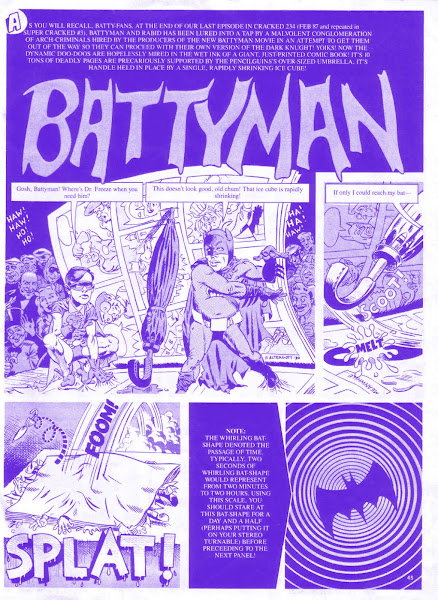
BATTYMAN
Cracked #234, March 1988
w: Charles Hall
a: Rick Altergott
Done two decades later when the conventions of the show were more well-known.
It may be bordering on conflict of interest to include people I know in this project, but like I said on another post, strips by them are few and far between when I have a 25-year statute of limitations. And if I excluded people I know, people may say “but why didn't you include this comic or that comic?”. Besides, what is it to “know” someone, anyway? Someone I see every day? Every few years? Do I have to have been to their house? Does it mean someone I've corresponded with? That I've worked with? That I run into at conventions? That I see at parties? I met Jack Davis once, I can't say I knew him. I had Harvey Kurtzman for a teacher and went to his funeral, but I don/t think he counts. I know Rick through his wife. Lots of cartoonist couples out there. But I digress. Here's this.
Bruce and Dick try to keep their secret identities from Bruce's Aunt Harriet (Madge Blake). They get a tip from Alfred, their butler who knows their identities, about a call on the Bat phone.
It's a call from Commissioner Gordon (Neil Hamilton) and Chief O'Hara (Stafford Repp). They have a tip that The Joker (Cesar Romero), The Riddler (Frank Gorshin), Penguin (Burgess Meredith), and Catwoman (Julie Newmar) are about to hatch a plot against Gotham City.
They parody how the show would often use odd camera angles.
They often had cameos by celebrities when they climbed buildings.
The criminal plan is to flatten them in a giant comic book and they're using Catwoman as bait.
It's kind of hard to read that last panel. It says, “Is this the end of Adam Wurst and Burp Ward as Battyman and Rabid? Looks that way, if the movie producers have their way! Congratulations, you wont be able to find out by simply tuning in... SAME BATTY-TIME! SAME BATTY-CHANNEL!” parodying the cliffhanger announcements they would have at the end of part one of a two-part show (see video clip below).
This was part of TV Scenes from the Cutting Room Floor in Sick #51, March 1967, drawn by Angelo Torres.
Then circling back again to MAD, here's a parody from the version when it only existed as a comic BAT BOY AND RUBIN
MAD #8, December-January 1954
w: Harvey Kurtzman
a: Wallace Wood
When they parodied Superman a few issues earlier, there was confusion from readers about whether what they printed was the real thing. These disclaimers put everything to rest.
Fleagle Gang was what Kurtzman called Al Williamson, Frank Frazetta, and other younger artists that were always hanging around the EC offices.
UPDATE:
This Sergio Aragones piece from MAD #106, October 1966, isn't exactly a parody, but was obviously done to cash in on the TV show.
From If Different Personalities Played Tarzan in Cracked #60, May 1967.
Part 2 of earlier 80s parody of 1966 show (see above) from Cracked #257 in October 1990. The first part was done three years earlier but the second part was made to cash in on the movie.
In the sequels to the 1989 movie, were Robin Williams originally considered for the Riddler, Michael Jackson for Robin, and Cher for the Catwoman? (Jerry Hall, who was in the first one, was married to Mick Jagger.)